How to Improve Indoor Air Quality Without an Expensive Purifier
Identify indoor pollution sources and use ventilation, source control, cleaning and filtration to create healthier air at home.
In this article
Understand first
Three things this evidence means for you
- 1Source control is the first step: reduce smoke and particles from cooking, tobacco, incense, waste, dust, and polluting household fuels.
- 2Ventilation helps when outdoor air is cleaner, but opening windows during a severe outdoor episode can bring pollution inside.
- 3Correctly sized particle filtration can reduce PM, while plants and fragrance products should not be treated as substitutes for source control and ventilation.
Major indoor pollution sources in Nepal
Indoor air contains pollution generated inside plus outdoor pollution that enters through windows, doors, vents, and leaks. Important sources can include solid-fuel cooking and heating, tobacco smoke, incense, mosquito coils, candles, frying, poorly vented gas appliances, dust, solvents, cleaning sprays, dampness, and mold.
The strongest intervention is often to remove or reduce the source. Filtering a room while smoke continues inside is less effective than stopping the smoke and then cleaning the remaining air.
Cooking and household combustion
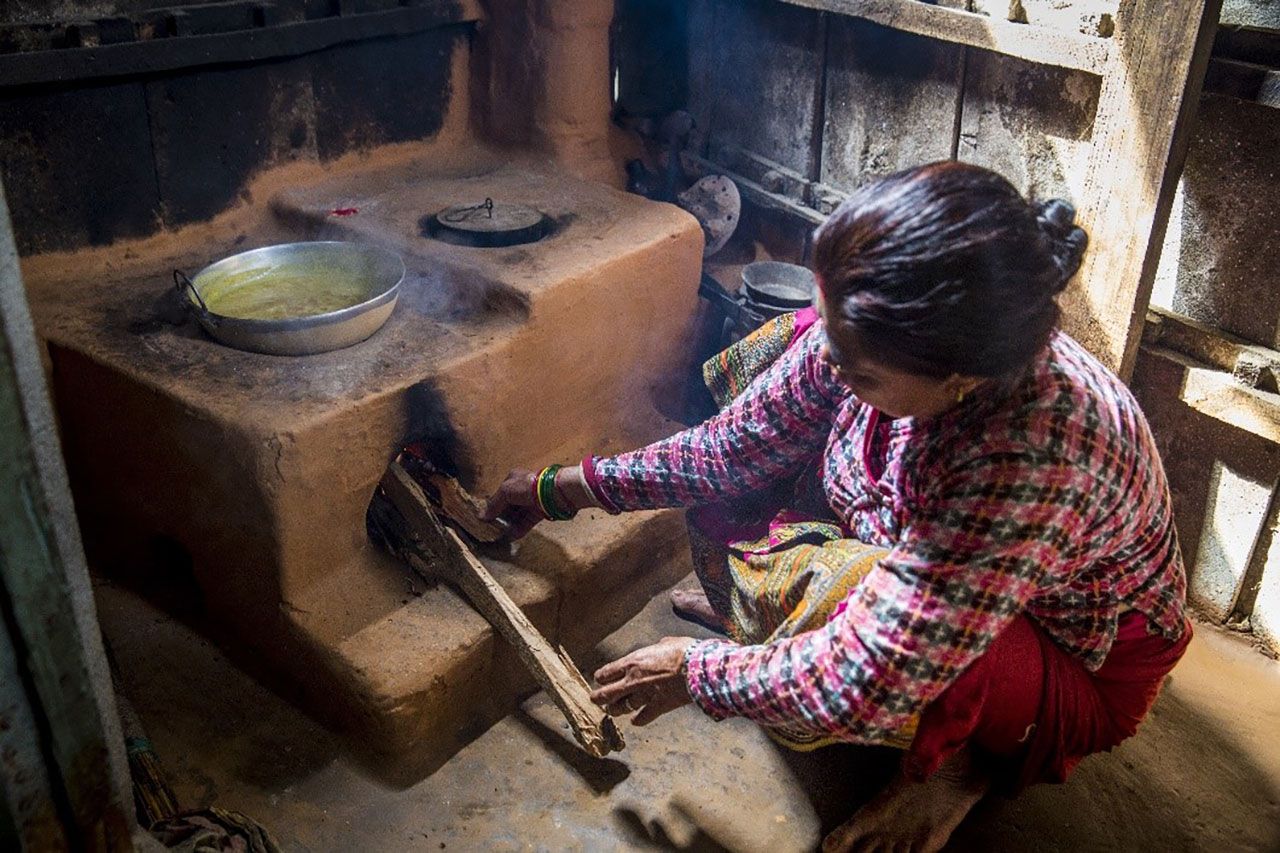
Open fires and inefficient stoves using wood, dung, crop waste, coal, or kerosene can produce harmful particles and gases. Cleaner fuels and technologies, safe installation, a separate kitchen where practical, and effective exhaust reduce exposure. A hood should vent outdoors rather than simply recirculate through a weak grease filter.
Never use charcoal or unvented combustion in an enclosed room. Carbon monoxide can be deadly and cannot be detected by smell. Install an appropriate alarm where available and follow appliance safety instructions.
When opening windows helps
Ventilation can dilute pollutants from cooking, cleaning, moisture, and occupants when outdoor air is cleaner. Cross-ventilation can move more air by using openings on different sides, while an exhaust fan removes pollution near its source.
When outdoor PM2.5 or smoke is high, wide-open windows can make indoor particle levels approach outdoor levels. Use the live outdoor trend, indoor conditions, heat safety, and moisture needs to choose a better ventilation window.
Dust, fabrics and cleaning
Cleaning products can also emit irritants. Follow labels, never mix chemical cleaners, use the least polluting product that works, and ventilate safely during and after use.
- Use damp cloths or wet methods instead of dry sweeping when practical
- Wash bedding and curtains regularly
- Clean under furniture and other dust reservoirs
- Use a vacuum with effective particle filtration if available
- Control moisture and repair leaks that support mold
Portable and DIY particle filtration
A portable air cleaner should be sized for the room. Smoke clean-air delivery rate, or CADR, is more useful than a marketing claim alone. Place the device where air can circulate, run it long enough to matter, and replace filters when dirty or according to instructions.
A carefully constructed box-fan filter can be a temporary lower-cost option when proven commercial products are unavailable. Use a modern safety-certified fan, a high-efficiency filter, a stable design, and adult supervision. Do not block exits or use damaged electrical equipment.
What indoor plants can and cannot do
Plants can improve comfort and wellbeing, but a few household plants do not provide enough air cleaning to replace source control, ventilation, or mechanical particle filtration. Wet soil can also support mold or allergens when overwatered.
Using an indoor air monitor
An indoor PM monitor can reveal peaks from cooking, incense, cleaning, or outdoor infiltration and show whether an intervention lowered them. Place it away from a stove, direct purifier outlet, open window, or humidifier unless testing that exact source. Focus on repeated patterns and clearly label sensor uncertainty.
Local context
A Kathmandu kitchen during a winter episode
A family cooks during a polluted evening with the windows closed. Frying raises indoor particles, but opening a street-facing window brings in outdoor PM2.5. A vented kitchen hood that exhausts safely outdoors, lower-emission cooking methods, and a particle cleaner in the main living space can reduce the combined problem. The family ventilates later when the outdoor reading improves.
Now act
Practical recommendations
- Do not smoke or burn waste indoors or near doors and windows.
- Use the cleanest practical cooking and heating technology available and vent combustion safely outdoors.
- Operate a kitchen exhaust hood during cooking when it vents outdoors and is maintained correctly.
- Ventilate when outdoor AQI is lower and indoor heat, moisture, and infection risks are considered.
- Damp-dust and clean bedding, curtains, and high-dust areas without aggressively resuspending particles.
- Choose a portable particle cleaner by room size and smoke CADR, and avoid devices that intentionally generate ozone.
- Use an indoor monitor to compare trends before and after interventions, not as a medical instrument.
Sources and methodology
The recommendations synthesize WHO household-air guidance and EPA indoor-air and filtration material. Building design, fuel access, outdoor pollution, heat, moisture, carbon monoxide risk, and electrical safety differ by home. Combustion appliances should be installed and serviced by qualified people.
- 1.Household air pollution and health: World Health Organization
- 2.Indoor air filtration: US Environmental Protection Agency
- 3.Strategies to reduce exposure indoors: US Environmental Protection Agency
Continue learning
Related action guides
 Air Quality 101
Why Air Quality Changes from Street to Street in Kathmandu
A single citywide AQI can hide important differences between busy roads, residential lanes and open spaces. Discover what creates Kathmandu’s hyperlocal pollution hotspots.
 Air Quality 101
What AQI Is Safe for Walking, Running and Outdoor Exercise?
Use AQI, activity intensity, health status, location and timing to decide when to walk, run, cycle or move exercise indoors.
 Air Quality 101
When Should You Wear an N95 Mask for Air Pollution?
Compare cloth, surgical, KN95 and N95 masks for particle pollution, and learn how fit, facial hair and replacement affect protection.