What Is AQI? How to Understand Air Quality Levels in Nepal
Learn what AQI numbers and colors mean, why apps can disagree, and how to use VayuDrishti to make safer daily decisions.
In this article
Understand first
Three things this evidence means for you
- 1AQI converts pollutant concentrations into a common health communication scale, and the highest sub-index usually determines the reported AQI.
- 2AQI is not the same as PM2.5 concentration, even when PM2.5 is the pollutant driving the result.
- 3Always check the pollutant, standard, update time, and local trend before comparing readings from different platforms.
AQI meaning in one sentence
The Air Quality Index is a communication tool that translates measured or estimated pollutant concentrations into a simpler number, color, category, and health message. Higher values represent greater concern for health under the chosen AQI system.
Concentrations use scientific units such as micrograms per cubic metre or parts per billion. AQI makes several pollutants easier to communicate on one scale, but it also hides detail, so the dominant pollutant and raw concentration still matter.
Which pollutants can determine AQI?
AQI systems commonly calculate separate sub-indices for regulated pollutants. The largest sub-index is generally reported as the overall AQI, although the exact pollutants and breakpoints vary by country and platform.
- PM2.5 fine particles
- PM10 inhalable particles
- Ground-level ozone
- Nitrogen dioxide
- Sulfur dioxide
- Carbon monoxide
AQI colors and the action they suggest
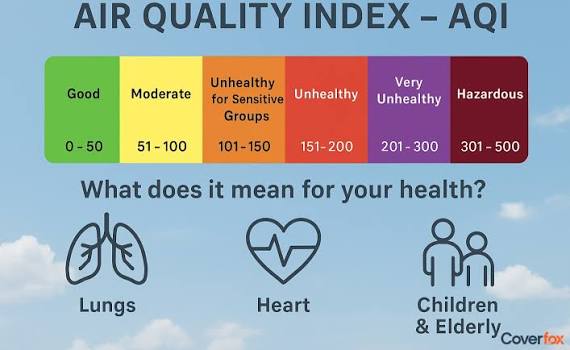
Color categories move from lower concern to increasingly unhealthy conditions. Under the widely used US AQI, green is Good, yellow Moderate, orange Unhealthy for Sensitive Groups, red Unhealthy, purple Very Unhealthy, and maroon Hazardous. Other systems may use different thresholds or names.
A category is a prompt to adjust exposure. As pollution rises, reduce duration and intensity, move away from the source, choose cleaner indoor air, and pay closer attention to symptoms. Sensitive people should usually make changes earlier.
AQI is not the PM2.5 concentration
A PM2.5 concentration is the estimated mass of fine particles in a volume of air. A PM2.5 AQI is the index value produced after that concentration is mapped through a particular set of breakpoints and averaging rules. A concentration of 80 micrograms per cubic metre therefore should not be described as AQI 80 without performing the correct conversion.
This distinction also explains why WHO guideline values and AQI category boundaries should not be treated as interchangeable. WHO guidelines are health-based concentration recommendations, while an AQI is a public communication system.
Why two air-quality apps can disagree
A difference does not automatically prove that one platform is wrong. Compare the pollutant concentration, location, timestamp, source type, and AQI standard first. Large or persistent differences should still be investigated.
- They may use different monitoring stations, models, or sensor networks
- Their readings may have different update times or averaging periods
- One may apply calibration or quality-control corrections
- They may use Nepal, US, or another international AQI standard
- One app may report current conditions while another emphasizes a forecast
Common AQI mistakes to avoid
- Treating one reading as representative of every neighborhood
- Ignoring the last-updated time
- Comparing AQI values calculated under different standards
- Assuming a mask removes every gas and particle
- Waiting for symptoms before reducing a clearly avoidable exposure
How to read the VayuDrishti Air Guide
Start with your selected location, current AQI category, dominant pollutant, and timestamp. Next, scan the hourly outlook for a cleaner window. Finally, use the activity guidance for your age, health, and plan. This sequence turns a scientific reading into a practical choice for the day.
Local context
Reading a VayuDrishti card before school or work
Suppose your city card shows an elevated AQI driven by PM2.5 and the hourly view suggests improvement later. The actionable interpretation is to reduce or delay strenuous outdoor activity, choose a route away from traffic, and check again before leaving. The number becomes useful when it changes a specific decision.
Now act
Practical recommendations
- Read the category and health message before focusing on the exact number.
- Confirm which pollutant is responsible for the AQI.
- Check the station or model location and the last-updated time.
- Use the hourly trend to plan activity instead of relying on a single screenshot.
- People in sensitive groups should act earlier and follow their clinician's advice.
- Do not compare two platforms until you know whether they use the same AQI standard and averaging period.
Sources and methodology
AQI breakpoints and category labels depend on the standard selected by a platform. VayuDrishti should identify the active standard and source context. This guide explains the concept and common interpretation errors; it does not replace national alerts or medical advice.
- 1.Air Quality Index basics: AirNow
- 2.Air Quality Index guide to health: AirNow
- 3.WHO global air quality guidelines: World Health Organization
Continue learning
Related action guides
 Air Quality 101
Why Air Quality Changes from Street to Street in Kathmandu
A single citywide AQI can hide important differences between busy roads, residential lanes and open spaces. Discover what creates Kathmandu’s hyperlocal pollution hotspots.
 Air Quality 101
What AQI Is Safe for Walking, Running and Outdoor Exercise?
Use AQI, activity intensity, health status, location and timing to decide when to walk, run, cycle or move exercise indoors.
 Air Quality 101
When Should You Wear an N95 Mask for Air Pollution?
Compare cloth, surgical, KN95 and N95 masks for particle pollution, and learn how fit, facial hair and replacement affect protection.